JOHN S. ALLEN'S BICYCLE FACILITIES, LAWS AND PROGRAMS PAGES |
||
 |
Top: Home Page Up: Bicycle sidepaths Contact John S. Allen by e-mail |
 |
JOHN S. ALLEN'S BICYCLE FACILITIES, LAWS AND PROGRAMS PAGES |
||
|
Top: Home Page Up: Bicycle sidepaths Contact John S. Allen by e-mail |
|
|
This page is a translation of the page (in German) "Radwege, rechtlich" by Bernd Sluka. Translation by John S. Allen, August 16, 2003; updated January 2, 2010 and August 2, 2019 to reflect updates to the German version. Laws concerning bikeways
|
||||||||||||||||||||||||||||||||||||||
|
|
|
is mandatory. Cyclists are generally required to use these. This is true of
bikeways to the right of the roadway as well as those to the left (left-side bikeways). The signs must be readable in the direction of travel -- riding is only permitted in the designated direction.
The mandatory-use requirement is troubling, because it is generally more dangerous to ride on sidepaths than in the streets. This is especially true of sidepaths on the left side of the street, where the crash risk is nearly twelve times as high.
If the sign is not repeated after an intersection, the mandatory bikeway use ends. The bikeway may continue, but its use is then optional.
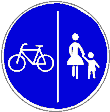
On paths shared with pedestrians, and on bicycle and pedestrian paths that run side by side, bicyclists may ride only with special attention to pedestrians, and must when necessary slow to pedestrian speed.
However, even sidepaths with signs indicating that they are mandatory need not be used under certain conditions. The exceptions, however, do not conform to the minimum requirements which were set forth by changes in the national traffic laws in 1997. The minimum requirements affect only what governments must do, and indicate when they may designate a sidepath and make its use mandatory. The requirements have no effect on the individual cyclist, who can, as a start, rely only on the presence or absence of a bikeway sign.
Exceptions to mandatory use have, however, been known for years through case law. Three conditions must be met for use to be mandatory. A path must be:
usable and
If a path fails to meet even one of these criteria, its use is not mandatory. Riding on the roadway is then permitted even if there is a designated sidepath.
Paths are not along a street if, for example, they are too far (generally 5 meters or more) from the roadway. A clear criterion for when they are not mandatory is that they do not have the same priority at intersections as the parallel street. Paths which are far from a parallel street or whose route is entirely independent of streets are not considered to accompany streets.
usable:
Sidepaths are not usable for example, if they
do not lead in the direction the cyclist intends to go (including, for example, when a bicyclist wants to turn left and must leave the sidepath early enough to take the appropriate location on the roadway).
are blocked by parked vehicles or other obstacles (for example, trash cans) or pedestrians walk on them, so they can not be used for bicycling,
are blocked in another way (for example, by piles of plowed snow), but also
are covered with snow, but the street has been cleared.
The unusable section is not mandatory, but also it is not necessary to switch back and forth between the sidepath and the roadway; rather, the cyclist should find as safe a place as possible to leave the sidepath before the obstacle, and a safe place to return to the sidepath. If the sidepath is unusable every couple of hundred meters, then the entire stretch need not be used at all, because a repeated and therefore somewhat hazardous change of route cannot be considered reasonable.
In this case, it is irrelevant whether the sidewalk is available, as cyclists must not ride on sidewalks, or even take detours on them. It is only legal to use the roadway or push the bicycle on the sidewalk -- and the latter, only if no problem is created for pedestrians. In any case, it is legal to walk with a bicycle in the street, as well as to ride.
What is "reasonable" can not be precisely defined. Certainly, under § 3 StVO a bicyclist is required to ride no faster than is safe under existing conditions. A poor surface (for example, rough pavement, slippery leaves, trash) is not enough by itself to disqualify a sidepath. If, however, it is not possible to compensate for the condition by adapting the style of riding, then use of the sidepath is unreasonable, and can not be mandatory.
What is "unreasonable" can possibly best be determined depending on whether the designated route can be conceived of as appropriate. This criterion excludes short stretches of sidepaths on the left side from mandatory use, because in this case it is necessary to cross the roadway, and so a definite danger is created. Also, repeated alternation between sections of mandatory sidepath and the roadway, or between sidepaths on the left side and right side is unreasonable.
Broken glass, trash, etc., for example, which lead repeatedly to tire punctures, also should not be accepted. .
Concerning the exceptions from mandatory use, see also Wolfgang Strobl's "50 reasons to avoid cycle paths", which can be understood as a collection of creative interpretations of the exceptions described above.
§ 44 VwVfG Abs. 2 Nr. 4 renders mandatory use on both sides of a roadway indicated by signs 237, 240 or 241 invalid, because it is not possible to comply with both requirements at the same time. The arrangement is for this reason legally unworkable, and so there is no mandatory use. Bicyclists may ride on the street at such locations. They may also ride on the bikeway on the right side, but this is not mandatory. Bicyclists may not ride on the bikeway on the left side, as it is not effectively open.
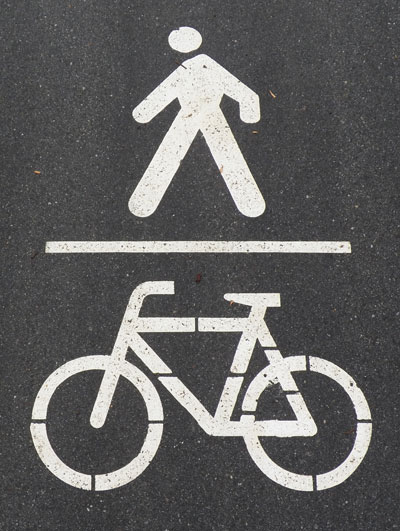
Non-mandatory sidepaths are "areas provided for bicycle traffic", but are not designated with signs 237, 240 or 241. If on the right side of the street, they may be used by bicyclists, but use is not mandatory. It is unclear, however, how they are to be identified. A separation between the bikeway and the roadway, and between the bikeway and sidewalk, is a good indication. Colored pavement on the bikeway or on part of the sidewalk is not sufficient, and neither is a simple white dividing line. Painted bicycle symbols or representations of sign 237 on the surface may possibly indicate a bikeway. The marking at the right identifies a combined sidewalk and non-mandatory bikeway. In case of doubt, the roadway should be used.
. Left-side non-mandatory sidepaths are identified by a supplementary plaque, . If not so designated, it is illegal to ride on paths on the left side of the street.
If there are a mandatory bikeway and a non-mandatory one or bike lane on both sides of the street, then mandatory use applies. The other option must not be taken. This type of arrangement of course doesn't make sense, and should be changed by the a[pppropriate government agency.
Similar rules apply to bike lanes on the roadway (separated by surface marking 295 -- a wide line denoting the edge of the travel lanes). In particular, the use of a bike lane is mandatory only when indicated by sign 237. The surface marking is not sufficient to indicate mandatory use (see also § 39 Abs. 5 no. 8 StVO); there must also be a sign. If there is no dividing stripe, the sign has no prescriptive effect; nonetheless, the sign is necessary to establish the mandatory use requirement, which depends only on the signage.
Protective lanes (Schutzstreifen), better called advisory lanes "Angebotsstreifen", are lanes on the right side of the roadway which are for the most part very narrow and are separated from the roadway by pavement marking 340 (guide stripe, dashed line). Theyare indicated using bicycle symbols as well. Without the symbols, they are not advisory lanes.
They are intended to protect bicyclists, but like sidepaths and bike lanes, they often have the opposite effect. Protective lanes must be used if wide enough. "Wide enough" means, above all, that it is not necessary to ride too close to the edge of the roadway, or within range of opening doors of parked cars. Case law prescribes specific shy distances away from sidewalks, about 70 to 80 cm, and from parked vehicles, at least one meter. If these distances can not be maintained within the protective lane, a bicyclist should ride alongside it to its left. The requirement to keep to the right is intended primarily to protect traffic coming from the opposite direction, not to force vehicles to travel at the extreme right edge.
Other vehicles must travel to the left of the advisory lane, but unlike with bike lanes, they may merge into the protective lane; for example, when they cannot otherwise pass oncoming traffic. However, they may not do this in such a way as to endanger bicyclists. Observation of actual street traffic makes it questionable whether this requirement is followed in practice.
Shoulders are strips at the right edge of the roadway, indicated using marking 295 (roadway edge; solid line) but not designated as bike lanes (by means of signs). Bicyclists may ride in them, if not causing problems for pedestrians. Farm vehicles, tractors and other slow vehicles must use them. In particular, standing and parked vehicles must use them.
Sidewalks and footpaths may be indicated with sign 239 (pedestrians). Supplementary plaque 1022-10

indicates that bicycling is permitted. This permission applies only in the direction from which the signs are visible, and only if the signs are repeated after each side road. Otherwise, the permission ends, and a bicyclist must ride on the roadway.
On such sidewalks and footpaths, bicyclists are tolerated as guests of the pedestrians. Cyclists must ride at no more than a walking speed and must take care around pedestrians, slowing and following the pedestrians when necessary. "Ringing away" pedestrians with the bicycle bell is prohibited.
This advice is also available (in German) for printing out as a Pamphlet in PDF format, "Sonderwege für Radfahrer".
(1) Vehicles must use the roadway. On a street with a median, vehicles must use the roadway to the right of the median. Shoulders are not part of the roadway.
(2) It is required to keep as far right as possible not only when there is oncoming traffic, but also when being overtaken, at hillcrests, in curves and when sight conditions are poor.
(3)[...]
(4) Cyclists must ride single file; they may ride side by side only when traffic is not impeded. They must use sidepaths designated for their direction of travel only when sign 237, 240 or 241 is posted. Sidepaths without sign 237, 240 or 241 may be used. Sidepaths on the left side without sign 237, 240 or 241 may only be used when "Radverkehr frei" (bicycle traffic permitted) is posted alone. Bicyclists may also use a shoulder on the right side if there is no sidepath and pedestrian use is not impeded. Outside built-up areas, mopeds also may travel on bikeways.
(5) Children through the end of their 8th year are required to ride bicycles on sidewalks, and through the end of their 10th year are permitted to. They must pay special attention to pedestrians. Children must dismount to cross roadways.
| Regulatory signs | ||
| 1 Num- ber. |
2 Sign and plaque |
3 Prescription or prohibition Explanations |
Section 5, Special facilities |
||
| 16 |  Bikeway |
Prescription or prohibition
|
| 18 | Sidewalk/footpath |
Prescription or prohibition
Explanation |
| 19 | 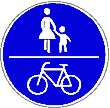 Combined sidewalk/footpath and bikeway |
Prescription or prohibition
Explanation |
| 20 |
|
Prescription or prohibition
Explanation |
| Guide signs | ||
| 1 Number |
2 Sign and supplementary plaque |
3 Prescription or prohibition Explanations |
Section 8, Markings |
||
| 16 | Dashed white
line Guide stripe 
|
Prescription or prohibition
Explanation |
&nbso;
2000-12-01 (© Bernd Sluka), most recently revised 2018-09-28
This text may be freely copied, linked and distributed, as long as the citation is complete,
unchanged and includes author contact information.
Good bikeways do not need a mandatory-use law.
 Auch auf
deutsch erhältlich!
Auch auf
deutsch erhältlich!